Solar Charger vs. Power Bank: What Do You Really Need for Backpacking?
Some links on this site are affiliate links. If you purchase something using an affiliate link, I may earn a small commission. This doesn’t cost you anything extra, and helps offset the costs of keeping this site online. Thank you for your support!
Do I need a power bank or a solar charger?
When you’re hiking or backpacking, your phone, GPS device, or camera can feel like essential gear. The question is: How do you keep your electronics charged in the backcountry?
Most people narrow it down to two options: a power bank or a solar charger. The trick is knowing which one you actually need—and when.
I’ll break down how to decide between a power bank and a solar charger, which ones I use, and tips for getting the most out of them on the trail.

Power banks for backpacking: When they’re enough
For trips up to 3–4 days, power banks are usually the better choice. They’re lighter, more reliable, and don’t depend on sunlight.
Some of the power banks I like:
- Goal Zero Flip – Small and portable 6,700 mAh charger (10,050 mAh version available, too)
- Anker PowerCore – my personal favorite. It balances weight and capacity and comes on nearly every trip with me. Mine is on older version – the newer ones are even better!
- Nitecore NB10000 –
I don’t actually own this one, but I know it’s a big favorite of ultralight backpackers.It’s on my ‘someday’ list!I went out on bought it! It’s very sleek and slim and so far I love it!
Product image not available.
⚡ Tip: Choose a power bank with enough milliamp hours (mAh) to cover your devices for your entire trip. For example, a 10,000 mAh power bank will usually charge a smartphone 2–3 times.

When you need a solar charger for backcountry camping
If you’re going beyond 4–5 days, or carrying multiple devices that will need charged, a solar panel becomes essential.
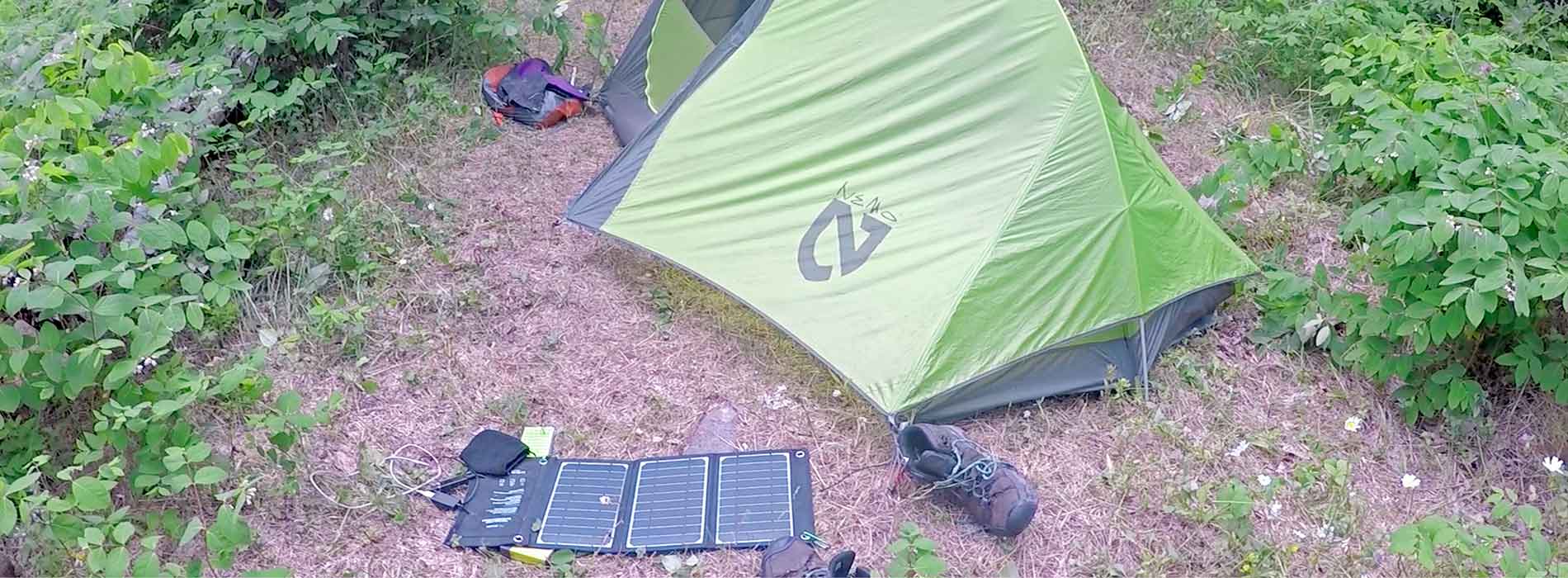
On my backpacking trip to Isle Royale National Park in Michigan, I carried a phone, GoPro, Garmin inReach, a watch, and a still camera. There was no way I could bring enough spare batteries or power banks to keep things charged up, so I packed a solar charger.
But on the West Highland Way in Scotland, I knew I’d occasionally have access to outlets. I skipped the solar panel and relied on power banks and spare batteries instead.
What kind of solar charger works?
Skip the brick-style “power bank with a little solar panel.” They’re heavy and barely collect energy. They’re just too small to catch a meaningful amount of sunlight.
Instead, I use a trifold solar charger (about 1 lb). It folds out, catches plenty of sun, and actually works.
⚡ Pro tip: Don’t plug your phone directly into the solar panel. Most electronics need steady current, so charge a power bank first, then charge your devices from that.

Tips for using power banks and solar chargers together
- Always bring a power bank. Even if you carry a solar charger, you’ll need it as a buffer between the panel and your devices.
- Keep devices topped off. Don’t wait until you’re at 5% battery.
- Angle solar panels toward the sun. Flat on the ground works, but angled is better.
- Carry spare camera batteries. Clouds and rain will kill your solar-charging efficiency – carry extra batteries to see you through.
- Use low-power modes. Airplane mode, dim screens, and energy-saving settings stretch your charge.

⚡ Pro tip: This solar light can also charge your devices. It’s only 2,000 mAh so don’t rely on it as your only power bank, but it can be enough to get your phone charged up enough to use in a pinch. I’ve used it for that more than once!
Final thoughts on power banks vs solar chargers
If your backpacking trip is short, stick with power banks. If you’re going for a longer off-grid trek, or carrying multiple devices, add a solar charger to your kit.
For me, a lightweight Anker power bank almost always comes along, and when if I’m off-grid for more than a few days y , my trifold solar panel earns its place in the pack.
| Feature | Power Bank | Solar Charger |
|---|---|---|
| Best for | Short trips (3–4 days), limited devices to charge | Long trips, off-grid, lots of devices to charge |
| Pros | Reliable, light, no sun needed | Unlimited power with sun |
| Cons | Heavy if you carry multiples, can get depleted | Useless in bad weather, have to carry the solar charger and a power bank |
| My pick | Anker PowerCore 10,000 – OR – Nitecore NB10000 | Big Blue 21W Trifold |
Watch the video: Do you need a solar panel or power bank?
Like the video?
Subscribe to my YouTube channel and see all my hiking, motorcycle, travel, and adventure videos.